
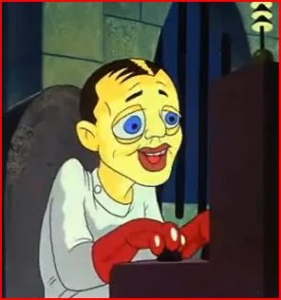
Even if you don’t know who Peter Lorre is, you know who he is. The scene-stealer from Casablanca, The Maltese Falcon, Arsenic and Old Lace, The Man Who Knew Too Much (1934), M, and Mad Love. Looney Tunes used his image for a character called, “Dr. Lorre”. His voice was copied for Ren & Stimpy, Super Mario Brothers, and as the voice of Boo Berry for the cereal.
So, who is this man who stole scenes in some of the greatest movies of all time?
Peter Lorre was born in what is now Slovakia in 1904. After early success in German films, including Fritz Lang’s masterpiece M, he wisely left Europe when Hitler took power. His first major role in Hollywood was our movie, Mad Love, where he played Dr. Gogol, the man who thinks it’s a great idea to replace the hands of a pianist with the hands of a killer.
Peter Lorre was a part of a well-known stable of actors at Warner Brothers, working with Humphrey Bogart, Claude Rains, and Sydney Greenstreet. With his huge eyes and unique accent, Lorre stood out in every scene. Near the end of his life, he again returned to his horror roots, working with Vicent Price in horror movies of the 1960’s.
Mad Love is based off the 1920 book, The Hands of Orlac, by Maurice Reynard. It was made into a silent movie in 1924, starring Lorre’s future Casablanca co-star and fellow refugee, Conrad Veidt.

The conceit of having an evil hand has been used repeatedly since in films and television, including The Crawling Hand (1963), The Hands of Orlac (1960), The Simpsons Treehouse of Horror, Angel, The Evil Dead, The Hand, The Beast with Five Fingers, and even Dr. Strangelove.
Also starring in Mad Love, Colin Clive plays the pianist with the killer’s hands. He notably played Dr. Victor Frankenstein in the Universal Studios horror movies with Boris Karloff. The killer, Rollo, is played by Edward Brophy, who you may remember from The Thin Man and as the voice of Timothy Q. Vance in Dumbo.
Come see Mad Love on the silver screen at our next pop-up movie screening AND Halloween Soiree! Silent horror movies we will have playing in the background of our cocktail party before the screening. Silent movies, particularly in Germany, were influenced by and helped shape the German Expressionist movement, with their distortion of reality, and stark shadows. Clips from Faust (1926), Nosferatu, The Cabinet of Dr. Caligari, and The Phantom of the Opera (1925), along with some lesser-known treasures, will accompany the party and lend atmosphere.